 Florida Accident Lawyers Gerson & Schwartz Accident & Injury Lawyers Home



Cruise Ship Jury Verdicts and Published Federal Court Decisions
Gerson & Schwartz, P.A. - Experience Litigating Against Major Cruise Lines
For more than 50 years, Gerson & Schwartz Accident & Injury Lawyers has represented individuals and families injured through negligence. Founded in Miami in 1970, our plaintiff-only law firm has extensive experience litigating cruise ship passenger injury cases against major cruise lines, including Carnival Cruise Line, Norwegian Cruise Line, Royal Caribbean International, and others.
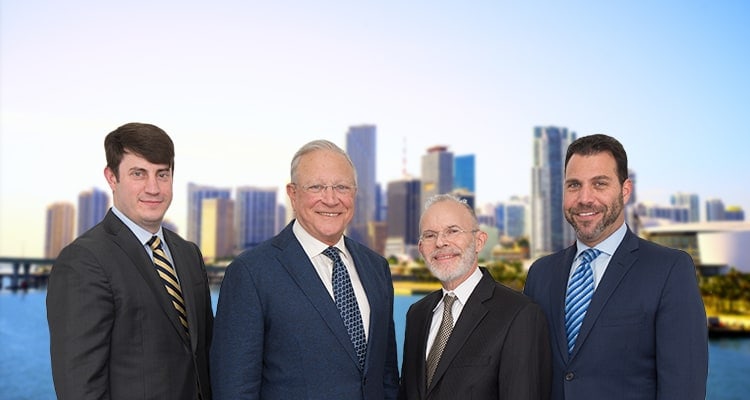
Our maritime attorneys, Philip M. Gerson, Nicholas I. Gerson, Edward S. Schwartz, and David L. Markel, have represented injured cruise ship passengers in federal court proceedings involving dangerous conditions, slip-and-fall accidents, stairway injuries, negligent maintenance, failure to warn, discovery disputes, and the admissibility of expert testimony.
The following representative cases illustrate our firm's experience obtaining jury verdicts, successfully opposing dispositive motions, and pursuing sanctions when cruise lines fail to comply with their discovery obligations.
Cruise Ship Jury Verdicts
Johnson v. Norwegian Cruise Lines - $7 Million Jury Verdict (2017)
Cruise ship slip-and-fall injury | Plaintiff jury verdict
Gerson & Schwartz obtained a $7 million jury verdict against Norwegian Cruise Lines in a cruise passenger personal injury case involving allegations of a dangerous condition and failure to warn.
The result was independently reported by TopVerdict in its 2017 Florida verdict rankings, which identify Philip M. Gerson, Nicholas I. Gerson, David L. Markel, and Edward S. Schwartz of Gerson & Schwartz as the plaintiff's attorneys.
This verdict reflects the firm's experience presenting contested cruise ship injury claims to a jury.
Butler v. Carnival Corporation - $396,000 Jury Verdict (2019)
Cruise ship personal injury | Plaintiff jury verdict
Gerson & Schwartz obtained a $396,000 jury verdict against Carnival Corporation in a maritime personal injury case.
TopVerdict's 2019 Florida premises liability rankings identify the firm's attorneys in connection with the verdict and classify the litigation as involving allegations of a dangerous condition, failure to warn, and failure to train.
The result provides additional independently published documentation of the firm's experience trying cruise passenger injury claims against major cruise lines.
Published Federal Court Decisions and Favorable Rulings
Villeta v. Carnival Corporation - Federal Court Upholds Rule 37 Sanctions (2014)
2014 WL 10250972 | Case No. 13-24369-CIV-ALTONAGA/O'Sullivan | Southern District of Florida
In Villeta v. Carnival Corporation, Gerson & Schwartz represented a passenger who alleged injuries arising from a dangerous floor condition aboard a Carnival cruise ship.
Following discovery disputes, Magistrate Judge John J. O'Sullivan imposed sanctions against Carnival under Federal Rule of Civil Procedure 37.
The sanctions established the element of Carnival's notice of the existence of a dangerous condition and struck affirmative defenses asserting lack of notice or the absence of a dangerous condition.
Carnival objected. On November 5, 2014, U.S. District Judge Cecilia M. Altonaga rejected Carnival's objections and upheld the sanctions order.
The ruling was significant because Carnival's notice of the dangerous condition was established for purposes of the case, although the passenger still had to prove the remaining elements of her negligence claim.
Read the federal court's November 5, 2014 order
Kartagener v. Carnival Corporation - Court Establishes Notice and Imposes Discovery Sanctions (2019)
380 F. Supp. 3d 1290 (S.D. Fla. 2019) | Case No. 18-CV-20974-KING/LOUIS
Gerson & Schwartz represented a passenger who alleged she slipped and fell on a wet elevator floor aboard a Carnival vessel.
During discovery, the firm challenged Carnival's failure to produce adequately prepared corporate representatives under Federal Rule of Civil Procedure 30(b)(6).
On May 17, 2019, U.S. Magistrate Judge Lauren Louis granted the plaintiff's motion for sanctions in part.
The court prohibited Carnival from taking certain positions at trial that contradicted the testimony of its unprepared corporate representatives. The court also determined that the element of notice of a hazardous condition was established.
The decision provides an important published example of the consequences cruise lines may face when they fail to meet corporate deposition and discovery obligations.
Read the published federal court opinion
Ramirez v. Carnival Corporation - Carnival's Motion for Summary Judgment Denied (2023)
Case No. 22-cv-21202-BLOOM/Otazo-Reyes | ECF No. 81 | May 3, 2023
Gerson & Schwartz represented a passenger who alleged she tripped on a defective stair nosing aboard the Carnival Vista and suffered injuries.
Carnival moved for summary judgment, arguing, among other things, that no dangerous condition existed, that it lacked notice, and that the plaintiff could not establish causation.
On May 3, 2023, U.S. District Judge Beth Bloom denied Carnival's motion for summary judgment.
The court determined that genuine factual disputes existed concerning the alleged dangerous condition, constructive notice, maintenance, and causation.
In the same order, the court denied Carnival's motion to exclude the plaintiff's treating physician and granted in part the plaintiff's motion challenging defense expert testimony.
The ruling allowed the plaintiff's negligence claims to proceed beyond summary judgment.
Ramirez v. Carnival Corporation - Prior Stairway Incident Evidence (2023)
Case No. 22-cv-21202-BLOOM/Otazo-Reyes | ECF No. 104 | May 8, 2023
In a separate pretrial evidentiary ruling in Ramirez, Carnival sought to exclude evidence of 12 prior stairway incidents involving the subject vessel and other vessels in the same class.
Judge Bloom rejected Carnival's request for categorical exclusion at that stage, finding that the prior incidents were not too remote in time and that differences between accidents did not automatically preclude their admission.
The court recognized that the plaintiff could potentially establish the necessary foundation for admission at trial.
The ruling illustrates the importance of investigating prior similar accidents and obtaining evidence concerning hazards on the same vessel or similarly designed cruise ships.
This was a mixed evidentiary order, and the court did not definitively admit all 12 incidents.
Chappell v. Carnival Corporation - Defense Expert Testimony Limited (2023)
666 F. Supp. 3d 1316 (S.D. Fla. 2023) | Case No. 21-cv-23787-SMITH/DAMIAN
Gerson & Schwartz represented a passenger who alleged serious injuries after slipping on a staircase aboard the Carnival Horizon.
The firm moved to exclude testimony from Carnival's retained toxicology expert, who sought to address the passenger's estimated blood alcohol concentration and its potential relationship to her fall.
On March 30, 2023, U.S. Magistrate Judge Melissa Damian granted the plaintiff's motion in part.
The court ruled that Carnival's expert could not testify that the passenger's alcohol consumption or its effects caused or contributed to her fall. The expert was permitted to testify about estimated blood alcohol concentration and associated physiological effects.
The decision illustrates the firm's litigation of expert admissibility issues in contested maritime injury cases.
Read the March 30, 2023 decision
Fawcett v. Carnival Corporation - Negligent Maintenance Claim Survives Dismissal (2023)
682 F. Supp. 3d 1106 (S.D. Fla. 2023) | Case No. 23-21499-CIV-ALTONAGA/Damian
In Fawcett, Gerson & Schwartz represented a passenger who alleged he slipped on a dangerous condition aboard a Carnival cruise ship.
Carnival moved to dismiss the complaint. On July 10, 2023, Chief U.S. District Judge Cecilia M. Altonaga found that the plaintiff had adequately pleaded notice of the allegedly dangerous condition.
Although the court dismissed the negligent-failure-to-warn count with leave to amend, it permitted the negligent-maintenance claim to proceed.
The ruling illustrates the distinction between pleading a cruise line's knowledge of a hazardous condition and separately pleading the requirements of a failure-to-warn claim.
Why These Decisions Matter in Cruise Ship Injury Litigation
Cruise ship accident lawsuits frequently involve disputes over whether a cruise line knew or should have known about a dangerous condition.
Proving a passenger's case may require substantial investigation, including:
- Prior accidents involving the same location or similar conditions
- Shipboard maintenance, inspection, and repair records
- Corporate representative depositions
- Photographs, video surveillance, and incident reports
- Cruise line safety policies and crew training
- Engineering, maritime safety, and medical expert testimony
The published decisions in Villeta, Kartagener, Ramirez, and Chappell illustrate the firm's experience litigating these issues before federal judges in the Southern District of Florida.
Experienced Florida Cruise Ship Injury Attorneys
Gerson & Schwartz represents injured cruise passengers in maritime negligence lawsuits arising from slip-and-fall accidents, defective stairways, dangerous gangways, negligent security, sexual assault, automatic door accidents, shore excursion injuries, and other incidents involving cruise lines.
Founded in 1970, the firm reports more than 350 jury trials and more than $300 million in verdicts and settlements across its personal injury and maritime practice.
Our attorneys represent injured individuals and families throughout Florida and nationwide in cruise ship injury cases.
Contact Gerson & Schwartz Accident & Injury Lawyers for a free consultation.
Miami, Florida
(305) 371-6000
Visit our cruise ship accident lawyers page
Representative results and court rulings are provided for informational purposes. A jury verdict is not necessarily the amount ultimately recovered. Favorable interlocutory rulings do not establish final liability or an ultimate plaintiff recovery. Prior results do not guarantee a similar outcome in another case.
Nelson v. Carnival Corporation - Court Imposes Sanctions for Failure to Prepare Corporate Representatives (2019)
2019 WL 2205899; 2019 U.S. Dist. LEXIS 87212 (S.D. Fla. May 9, 2019)
Case No. 18-23292-CIV-MORENO/LOUIS
In Nelson v. Carnival Corporation, Gerson & Schwartz represented a plaintiff in federal maritime litigation against Carnival Cruise Line.
During discovery, the firm challenged Carnival's failure to adequately prepare its designated corporate representatives to testify concerning matters identified in deposition notices pursuant to Federal Rule of Civil Procedure 30(b)(6).
On May 9, 2019, U.S. Magistrate Judge Lauren F. Louis issued a decision imposing sanctions for Carnival's repeated failure to prepare corporate representatives for deposition.
The ruling illustrates the importance of requiring cruise lines to produce corporate witnesses who are adequately informed about the matters designated for examination. Under Rule 30(b)(6), a corporation must prepare its representatives to testify about information reasonably available to the organization, not merely the witnesses' personal knowledge.
The decision provides another example of Gerson & Schwartz's experience pursuing discovery sanctions in federal cruise ship litigation.
Ledet v. Carnival Corporation - Federal Court Orders Adverse Inference Sanction for Spoliation of Evidence (2019)
Case No. 1:18-cv-24737-SULLIVAN/LOUIS
U.S. District Court, Southern District of Florida | November 11, 2019 | ECF No. 115
In Ledet v. Carnival Corporation, Gerson & Schwartz represented a plaintiff in maritime personal injury litigation against Carnival Cruise Line.
During the litigation, the firm pursued sanctions arising from Carnival's failure to preserve evidence relevant to the plaintiff's claims.
On November 11, 2019, U.S. Magistrate Judge Lauren F. Louis entered an order finding bad faith in Carnival's conduct and ordering an adverse inference sanction for spoliation of evidence.
An adverse inference sanction can permit a jury to draw an unfavorable conclusion against a party that improperly failed to preserve relevant evidence, subject to the terms of the court's order.
The ruling is particularly significant in maritime injury litigation because cruise lines often possess or control important evidence concerning passenger accidents.
The decision illustrates Gerson & Schwartz's experience litigating evidence preservation disputes and pursuing sanctions for discovery misconduct in federal court.



 Your Privacy Choices